Choose Mumble Aloud to start with ready-made clues that expect a spoken answer. Choose Anki when your priority is practising your own vocabulary list through flashcards and scheduled review. On iPhone, the official app is AnkiMobile Flashcards, linked by the Anki project.
Start with the words you need—or with a game
If you have fifteen Czech words from a lesson, a personal deck lets you focus on those words. Anki supports cards containing images and audio, as well as text. You can build your own material or use a shared deck, whose content and quality you should check.
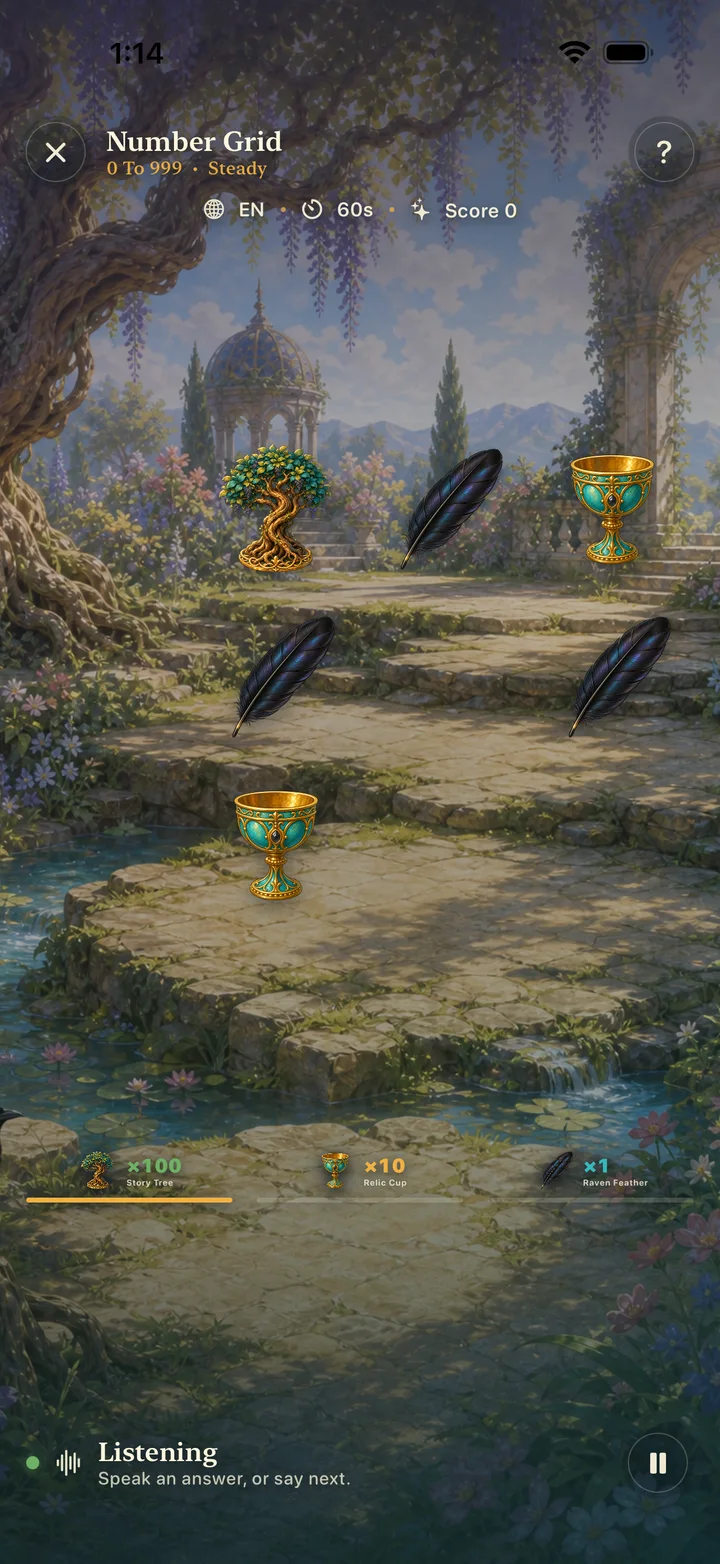
Mumble Aloud supplies the material through four puzzle formats: Number Grid, Memory Grid, Sound Source and Match Deck. The point is to solve a clue and retrieve its answer out loud. It is not an editor for importing your own vocabulary deck.
| Your decision | Mumble Aloud | Official Anki / AnkiMobile |
|---|---|---|
| Which words appear | Answers come from the game and stage you select. | Your own cards or a selected shared deck. |
| What prompts the answer | Quantities, remembered pictures, sounds or picture connections. | Card content can include text, images and audio. |
| What you do after recalling | Say the expected answer for speech recognition. | Reveal the answer and rate your recall; you can choose to speak first. |
| How you return to material | Select and revisit game stages. | Scheduled card review based on the study workflow. |
| Voice recording | Recognises game answers using Apple speech services. | AnkiMobile documents Record Voice for temporary recording and comparison. |
Anki can be part of spoken practice
Flashcards do not force you to answer silently. You can say a Czech answer before revealing a card, listen to supplied audio and then rate how well you recalled it. AnkiMobile’s Record Voice tool can temporarily record your voice so you can compare it with audio on a card.
That recording feature should not be described as an automatic pronunciation assessment. Likewise, Mumble Aloud recognising an expected word is not a detailed pronunciation score. The two workflows give speech different roles without establishing that either assesses conversational fluency.
Two concrete ways to practise
For words from your own lesson: prepare cards for a small set, check the Czech spelling and any audio, say your answer before revealing it, and rate your recall honestly. This is a suggested Anki routine based on its documented study tools. We have not tested a particular Czech shared deck or recording setup.
For a ready-made spoken puzzle: select Czech in Mumble Aloud, choose a familiar stage, solve a clue and say the answer. In Memory Grid, the extra task is remembering which pictures were shown. In Number Grid, it is working out a quantity. Our Czech practice guide includes a worked number example.
Use Anki when control over the exact material is essential. Use Mumble Aloud when the clue and the game are what make you want to speak. Neither option removes the need to use vocabulary in meaningful sentences and conversations elsewhere.
Check the iPhone app and your setup
Follow the Anki project’s link to AnkiMobile to avoid confusing it with similarly named flashcard products. Platform prices and capabilities can differ; check the official iPhone listing rather than assuming the desktop app’s terms apply to your phone.
Mumble Aloud’s public release is free with no in-app purchases. It supports English, Czech and Italian answers and has an English interface. Speech recognition needs the appropriate permissions, and offline availability varies by device and language. Those constraints matter if you expect to practise somewhere without a connection.
Sources and perspective
Exricel Studios makes Mumble Aloud. We compared documented features in the current public releases and official developer sources, checked on 9 September 2026. We have not performed hands-on testing of the competing apps. Recommendations here concern the activities they describe, not measured learning results, recognition accuracy or overall quality. Store availability, prices and access terms can vary by country and change over time.
- Mumble Aloud — current App Store release
- Anki — official apps and download links
- Anki manual — studying and rating recall
- AnkiMobile — study tools and Record Voice
Try Mumble Aloud. See the game and its screenshots, or open its App Store page.
The current App Store release is free, with no in-app purchases.